Oral Cancer Screening: What It Involves and When to Get Checked
Who is at risk for oral cancer, the early signs worth watching, what happens at a screening and biopsy, and why a sore lasting two weeks needs a look.

Much of my work in La Jolla involves evaluating spots, patches and sores in the mouth that a dentist or physician has flagged. Most of them turn out to be harmless. Some need treatment. A few are early cancers, and those are the cases where an early look makes the biggest difference.
This article explains who is at higher risk, what to watch for, and what actually happens during a screening and a biopsy, so a referral feels less mysterious.
Why early detection matters
Oral and oropharyngeal cancers are not among the most common cancers, but they are often found later than they should be. Early lesions are usually small and often do not hurt, so they are easy to dismiss as a canker sore or a bite on the cheek.
When oral cancer is found at an early stage, treatment is typically less extensive and outcomes are considerably better than when it is found late. That is the whole point of screening: to catch changes while they are small and simple to address.
Who is at higher risk
Anyone can develop oral cancer, including people with none of the risk factors below. Still, some factors raise the odds:
- Tobacco in any form: cigarettes, cigars, pipes, chewing tobacco and snuff.
- Heavy alcohol use, particularly combined with tobacco. Together, the risk is much higher than either alone.
- Human papillomavirus (HPV), especially HPV-16, which is linked to cancers of the back of the throat, tonsils and base of the tongue. These are increasingly seen in younger adults who have never smoked.
- Sun exposure for cancers of the lip, a real consideration in Southern California for anyone who surfs, sails, golfs or works outdoors.
- Age over 40, although cases occur at any age.
- A weakened immune system, a prior head and neck cancer, or certain long-standing conditions of the lining of the mouth.
Signs worth paying attention to
The single most useful rule is this: any sore, patch or lump in the mouth that has not healed in two weeks should be examined. Most mouth sores heal within 7 to 14 days. Something that persists beyond that deserves a professional look, even if it does not hurt.
Other changes to mention to your dentist or to us:
- A white patch (leukoplakia) or red patch (erythroplakia) that does not rub off.
- A lump, thickening or rough area on the gums, tongue, cheek or floor of the mouth.
- A sore on the lip that crusts, heals partially and returns.
- Numbness of the tongue, lip or chin without an obvious cause.
- Persistent hoarseness, a sore throat or a feeling that something is caught in the throat.
- Difficulty swallowing or moving the tongue or jaw.
- A lump in the neck that has been present for more than two to three weeks.
- Loose teeth or a denture that suddenly no longer fits, without another explanation.
None of these automatically means cancer. Infections, irritation from a sharp tooth, and many benign conditions can look similar. The only way to know is to have it evaluated.
What happens during a screening
An oral cancer screening is quick, typically 10 to 15 minutes, and does not hurt. Your dentist likely does a version of it at every checkup. When you are referred to an oral surgeon, the exam is more focused.
- History. We ask how long the area has been present, whether it has changed, and about tobacco, alcohol, sun exposure and medical history.
- Visual exam. We look carefully at the lips, gums, cheeks, tongue (including the sides and underside), the floor of the mouth, the palate and the back of the throat.
- Touch. We feel the tissues of the mouth and the lymph nodes of the neck and jaw for lumps or firmness.
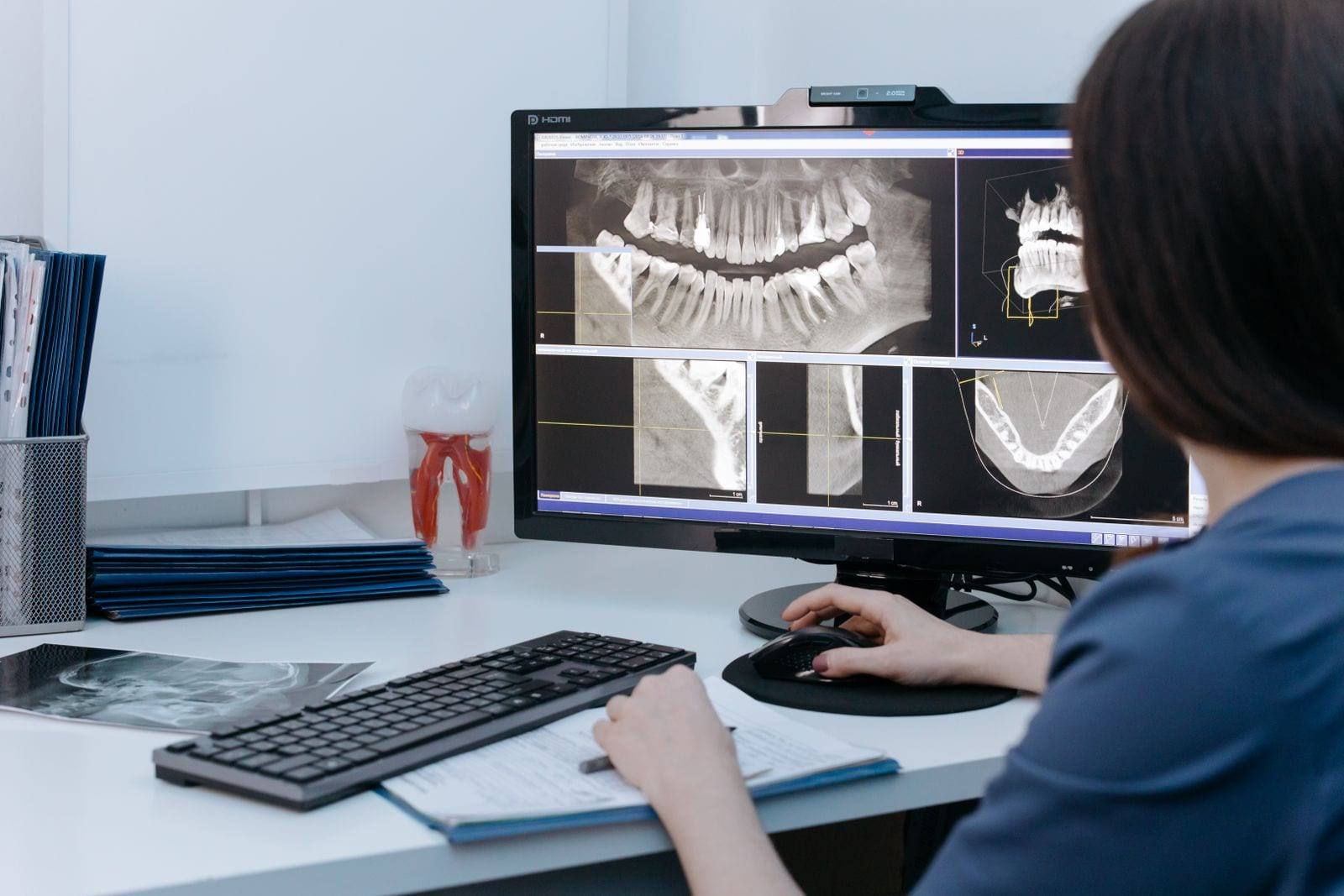
- Imaging if needed. If a change involves the bone, a panoramic X-ray or 3D CBCT scan helps us see what is going on beneath the surface.
At the end, I will tell you what I think it is and what I recommend. Sometimes that is simply removing an irritant and checking again in two weeks. Sometimes it is a biopsy.
What a biopsy involves
A biopsy is the definitive test. It sounds intimidating, but for most mouth lesions it is a short, straightforward procedure.
- It is usually done in the office under local anesthesia, the same numbing you would have for a filling. IV sedation is available if you prefer.
- We remove either a small piece of the area or, if it is small, the whole thing. The procedure typically takes 15 to 30 minutes.
- A few dissolving stitches close the site. Most patients take over-the-counter pain medicine for a day or two.
- The tissue goes to an oral and maxillofacial pathologist, a specialist who examines it under the microscope. Results usually come back within about a week.
I review every result with the patient directly, by phone or in person. Most biopsies come back benign. If the result shows precancerous changes or cancer, we explain what it means, what the next steps are, and coordinate with the head and neck specialists who will be involved in your care.
Biopsies and pathology are usually billed to medical insurance. We check your coverage first and give you a written estimate of your share.
Protecting yourself between visits
- Avoid tobacco in all forms, and keep alcohol moderate.
- Use a lip balm with SPF 30 or higher whenever you are outdoors.
- Ask your physician about the HPV vaccine for eligible ages.
- Keep regular dental checkups, which include a basic screening.
- Take a look in the mirror once a month, including under your tongue, and note anything new.
When to call
If you have a spot in your mouth that has lasted more than two weeks, please do not wait for it to hurt. Most of the time, it will be nothing serious, and you will leave with peace of mind. You do not need a referral to see a Molly surgeon, and most consultations can be booked within 48 hours. If something has changed quickly, tell us when you call so we can see you sooner.
About the author
Dr. Priya Raman, DDS, MD
Dr. Raman diagnoses and treats oral lesions, performs biopsies and cancer screening, and treats TMJ disorders at Molly La Jolla.
This article is for general education and isn’t a substitute for an examination. If you have symptoms, see your dentist or book a consultation with an oral surgeon.